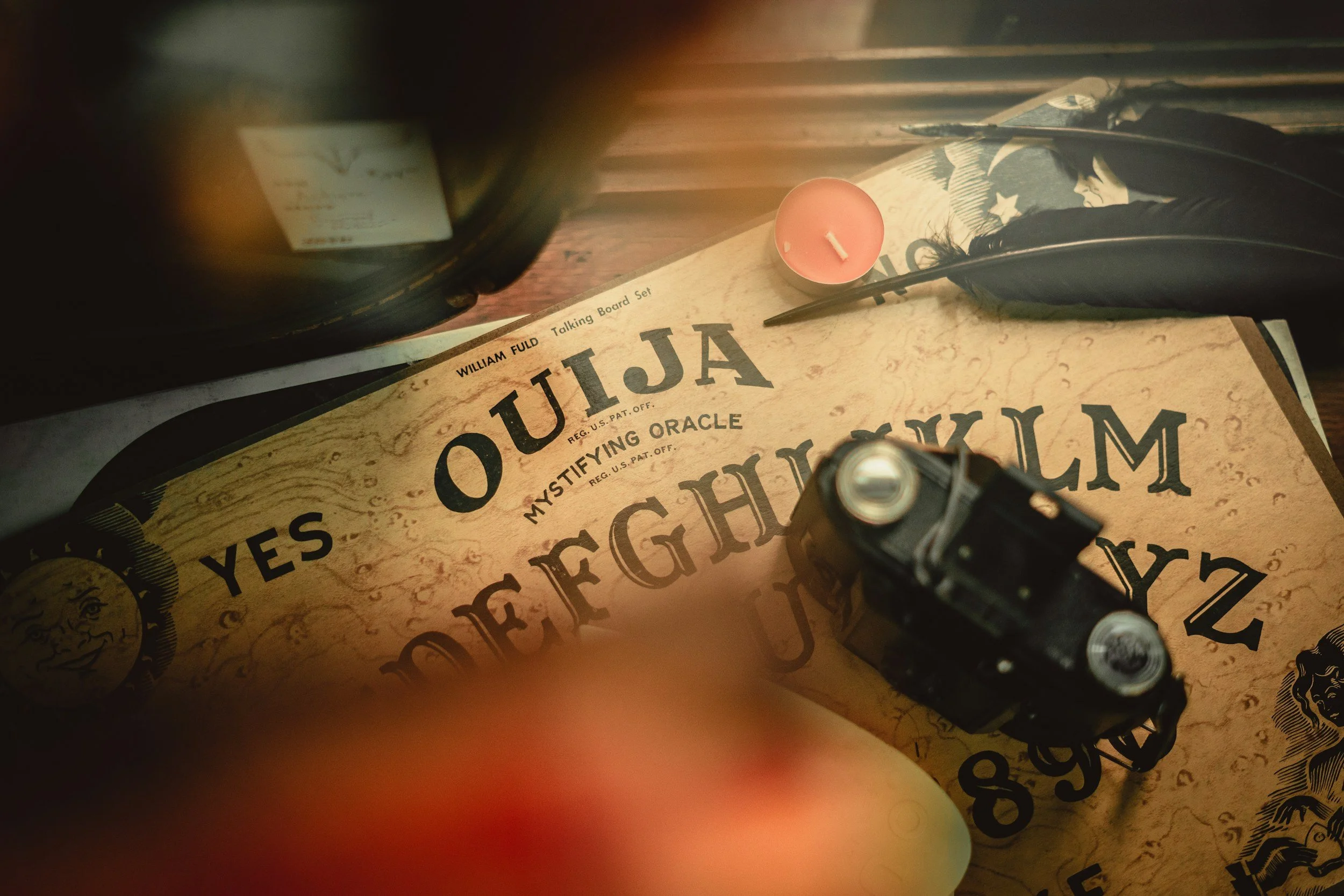
Ouija or spirit boards are lettered boards used with a planchette to spell messages. Science attributes motion to the ideomotor effect, while many practitioners frame results as spirit contact. Safe use means a calm group, clear boundaries, respectful questions, time limits, and always closing by moving the planchette to Goodbye.
How does spirit boarding work?
A spirit board session places one or more fingertips lightly on a planchette that glides across letters, numbers, and yes or no markers. Historically, talking boards were commercial parlor tools from the late 1800s, later adopted by Spiritualists and popular culture. Most laboratory work explains planchette movement through the ideomotor effect: tiny, unconscious muscle movements that track expectations and group dynamics. Studies with eye tracking and group tasks show that people often anticipate letters before the planchette arrives there, and participants underestimate their own contribution to the motion. The effect is stronger when attention drifts and when a group shares belief or a narrative about the session.
Outside scientific settings, many mediums and occult practitioners treat the board as a way to engage with spirits or the dead. Some religious authorities, especially in Christian contexts, discourage or forbid any use and warn of demonic risk. These perspectives cannot be resolved by experiment. Readers weighing the question might compare the scientific mechanism with spiritual claims. A balanced primer that asks are spirits real? can help frame what a practitioner expects, how interpretation works, and where to set personal boundaries.
If a session is approached as spirit contact, some practitioners adopt protocols similar to mediumship. This can include calling protective forces, establishing house rules, and screening alleged entities. An overview of entities and the Ouija board outlines common classifications and cautions used by experienced users. Whether one takes a psychological or spiritual view, the messages may feel meaningful. Keep that sense of meaning separate from literal truth, and avoid using board results for health, legal, or financial decisions.
How to use a spirit board safely
Many mistakes stem from rushing in or playing while distressed. The steps below aim to reduce confusion and prevent sessions from spiraling into fear.
Assess readiness: Skip the board during grief spikes, panic, intoxication, or sleep deprivation. Sessions are more stable with grounded, rested participants.
Choose a small group: Two to four calm users plus a scribe works well. Larger groups fracture attention. Avoid using the board alone.
Set the space: Quiet room, stable table, good lighting. Place the board on a smooth surface. Remove rings or bracelets that snag.
Agree on intention and limits: Decide acceptable topics, time cap, and stop rules. See the role of boundaries in spirit communication for practical boundary-setting methods.
Ground and center: A minute of breathwork or a brief guided grounding reduces tension. If practicing energetically, shielding rituals may help some users focus.
Hand placement and pressure: Two or more participants rest fingertips lightly on the planchette. Keep pressure minimal so movement is noticeable even with small impulses.
Calibrate: Ask neutral yes or no questions with known answers to get a feel for drift and speed. This is also a good time to rehearse the Goodbye motion.
Question hygiene: Use clear, brief questions. Avoid leading phrasing. Do not ask about medical diagnoses, death dates, or irreversible choices.
Observe time and state: Limit the first session to 15 to 30 minutes. If anxiety rises, stop promptly. A scribe or observer can track responses and group mood.
Close formally: Move the planchette to Goodbye. Remove hands. If anything feels lingering or agitating, conclude the session and tidy the space before debriefing.
Interpretation benefits from skepticism and self-awareness. A short primer on spiritual discernment explains how practitioners evaluate impressions, test claims, and avoid being carried by wishful thinking. If a session becomes aggressive or frightening, end it. Strategies for escalation are outlined in how to deal with hostile spirits. Also review common misperceptions about communicating with spirits to prevent common pitfalls.
Best Ouija board: what to buy or make
The “best” board is readable, steady, and easy to glide on. Consider these factors instead of brand hype:
Lettering and layout: High contrast letters, generous spacing, and a smooth alphabet arc reduce misreads.
Surface and glide: Laminated wood or acrylic with felt feet on the planchette moves predictably. Cardboard works, but humidity and warping cause drag.
Size: Larger boards suit groups and allow slower, clearer travel between letters.
Minimal artwork: Busy graphics distract eyes and influence ideomotor expectations. Simple designs reduce bias.
Planchette window: A clean, centered window makes letter selection clear to all participants.
DIY options are viable. A printed board on smooth cardstock with a coin or glass as a planchette can perform comparably for short sessions. Seal the print or use a clear sheet protector to improve glide. If printing, ensure the font is bold enough to read from a meter away.
Option What it is Pros Cons Best for Commercial physical board Manufactured board and planchette set Durable, consistent glide, readable Cost, variable build quality across brands Regular group sessions, collecting DIY print Printed board plus coin/glass planchette Low cost, customizable size and font Wear from use, needs lamination for smoothness First tries, workshops, travel App Mobile simulation of board or planchette Accessible, solo-friendly, tutorials included No shared ideomotor effect, privacy/ads Entertainment, personal journaling Browser “online board” Website version with click or drag Free, no install, easy to demo Latency, randomness, distractions Curiosity, casual play
Best Ouija board app (Android, free, and privacy)
Apps simulate a board or animate a planchette. Some randomize letters. Others script responses for atmosphere. Because users are not jointly guiding a physical planchette, the ideomotor component is replaced by code. Treat any results as entertainment or as prompts for self-reflection rather than external messages.
Selection tips for Android or other platforms:
Transparency: Clear description of how responses are generated. Avoid apps that claim guaranteed spirit contact.
Privacy: Check permissions. “Free” often means targeted ads or analytics. Offline-capable apps reduce tracking.
Interface: Large, legible letters and a manual mode if you want to slide a virtual planchette.
Safety features: Easy stop, session timer, and an on-screen Goodbye.
Free versions can be fine for curiosity. Expect ads and fewer settings. Paid or ad-free versions may be calmer to use. When anxiety rises, close the session and switch to grounding activities instead of chasing more answers.
Best Ouija board online and best Ouija board game
Online boards in a browser are simple demonstrations. They typically rely on random or rule-based outputs. If the goal is a shared psychological experience, a physical board with a small group is closer to classic use. If the goal is spooky fun, many themed party games riff on the idea without simulating communication. As with apps, treat web boards as entertainment, not authority.
Best Ouija board questions (including Phasmophobia)
Steer questions toward clarity and low stakes. Avoid health, death, crimes, finances, and irreversible decisions. Practitioners commonly begin with calibration, then general topics. Here are examples to keep early sessions simple:
Is anyone willing to communicate?
Can yes be used for the right side and no for the left?
Do you understand the boundary of respectful questions only?
Is now an acceptable time to continue?
Should the way questions are asked be adjusted?
Can you point to the first letter of your name?
Is there a message that can be recorded briefly today?
Verification questions should be specific but noninvasive. If a board claims a historical name, ask for a verifiable detail that can be checked later in public records, not private data. If responses become insulting or coercive, stop the session and close with Goodbye.
For the video game Phasmophobia, the in-game Ouija mechanic responds to a fixed set of prompts. Players commonly use short, recognized questions such as:
Where are you?
How old are you?
Are you friendly?
How many are here?
When did you die?
What is your favorite room?
Those are game-specific triggers rather than guidance for real-life boards. Keep the two contexts separate to prevent importing game tropes into practice.
Spirit board and pendulum: using both
A pendulum is a weighted object on a chain that swings in response to tiny muscle movements. Some practitioners use it to warm up focus before touching a planchette, or to confirm yes or no after a message. A practical overview of planchette and pendulum techniques explains common patterns, calibration tips, and typical mistakes.
When combining tools, keep procedures clean. Calibrate the pendulum’s yes and no. Do not let one person dominate interpretations. If answers conflict or you feel pressured to force a result, stop and reset boundaries.
How many in a spirit boarding group?
Two to four participants is a common sweet spot. Fewer than two loses the cross-checking that prevents one person’s expectations from steering the session. More than four increases chatter and fatigue.
Suggested roles for clarity:
Operators: Two people with fingertips on the planchette.
Scribe: One person notes letters, timestamps, and mood shifts. The scribe can also read back partial words to confirm.
Observer or facilitator: One person monitors time, airflow, and distractions, and calls for a break if agitation rises.
Switch roles every 10 to 15 minutes to prevent numb fingers and drift. Keep water nearby, and take a short break if the planchette begins to skid from sweaty palms.
Spirit board (very scary) game: what to expect vs hype
Horror marketing primes fear. Fear increases sensitivity to creaks, drafts, and ambiguous motion, which then feel like proof of an outside force. This loop can escalate quickly. Treat the board as a tool that amplifies attention and group expectation. If participants are already frightened, postpone the session. If at any point someone feels coerced or panicked, say Goodbye and stop. Rational debriefing and a snack often help re-ground the group.
Not about air travel: spirit boarding pass, print pass, and boarding groups
Queries like “how to get spirit boarding pass,” “how to print spirit boarding pass,” and “how many spirit boarding groups” refer to Spirit Airlines check-in and gate procedures. They are unrelated to spirit boards. For travel needs, use the airline’s official channels. For occult practice, use the safety guidelines in this article.
Common mistakes with Ouija and spirit boards
Using the board alone: Reduces cross-checking and can magnify anxiety. Use a small group.
Skipping a clear close: Always move to Goodbye. Leaving a session open invites rumination.
Treating messages as literal facts: The ideomotor effect and group bias are strong. Keep claims provisional and verify later.
Asking high-stakes questions: Health, death, or legal issues do not belong on a board.
Forcing movement: Heavy hands create friction and confusion. Light touch works best.
Playing while distressed or intoxicated: Heightens fear and misinterpretation.
Provoking “entities” for a scare: Irreverent dares can fuel group panic. Maintain a respectful tone or skip the session.
Where to start: a simple, safe first session
Use the smallest useful setup. Two calm people, a simple board, and a 20-minute cap. Prepare the space and agree on limits. Try a centering breath, then five calibration questions. If the planchette drifts, proceed with brief, low-stakes questions. Keep a neutral attitude. End by moving to Goodbye, remove hands, and record thoughts. If anything felt off, take a short walk, hydrate, and read about spiritual discernment to help parse impressions. If the session ever feels pressured or hostile, stop and review how to deal with hostile spirits before trying again later.
Many concerns around spirit boards are narrative and cultural. A calm, structured approach reduces the power of that narrative. An article on common misperceptions about communicating with spirits answers frequent worries and highlights what users often misread during sessions. If one’s framework includes spirits, review entities and the Ouija board and the role of boundaries in spirit communication to set clear rules before any future work. If one prefers a scientific lens, focusing on ideomotor research and group dynamics can keep expectations realistic and sessions emotionally manageable.
If you want to go further with this, my class space/time magic walks you through how to use ouija boards for space/time magic and spirit contact