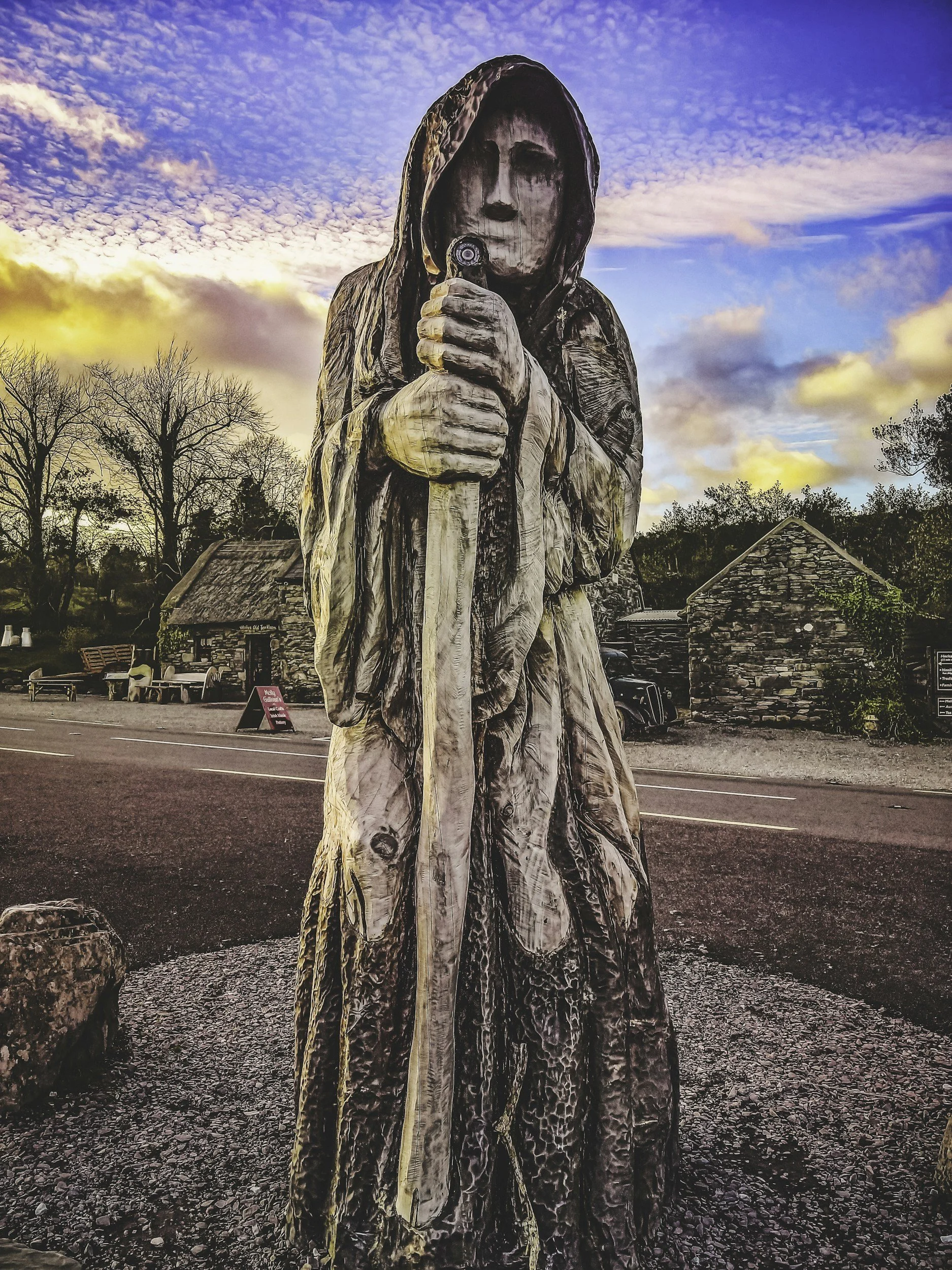
The crone meaning has two distinct layers: historically, crone was a disparaging word for an old woman; in modern feminist spirituality and Neopaganism, it has been reclaimed as an elder archetype associated with experience, authority, mortality, and later life. The positive Maiden-Mother-Crone model is modern, not an unchanged ancient doctrine.
Historical Origins of the Crone Meaning
The word crone first appeared in the late fourteenth century, deriving from the Anglo-French word carogne, which translates to carrion or carcass. In its original context, the term was used as an insult directed at older women, emphasizing physical decline and associating age with decay. For centuries, this negative connotation persisted in European literature and folklore, where older women were frequently depicted as malicious figures, hags, or witches who posed a threat to societal norms.
Early modern witch prosecutions drew on gendered ideas about malice, dependency, piety, and disorder, but no single profile explains the accused. In some communities, age, poverty, widowhood, reputation, or neighborhood conflict increased vulnerability; elsewhere the patterns differed. The popular claim that accused witches were mainly midwives or healers is not supported as a general explanation. Literary images of the malicious old woman interacted with these anxieties, but they should not be substituted for local trial records.
The reclamation of the word began in the mid-twentieth century, driven by the emergence of modern Neopaganism and feminist spirituality. Writers and practitioners sought to challenge the negative stereotypes associated with aging and to create a spiritual framework that honored the entire life cycle of women. By redefining the term, they transformed a historical insult into a symbol of respect, emphasizing the value of lived experience and the unique perspectives that come with age.
The Modern Triple Goddess Framework
The contemporary spiritual use of crone is closely linked to the Maiden-Mother-Crone framework. Robert Graves's 1948 book The White Goddess was influential in presenting triadic goddess ideas as ancient and far-reaching, although his historical method is not accepted as proof of one universal religion. Later feminist-spirituality and Neopagan writers helped standardize Maiden, Mother, and Crone as a life-cycle model. The familiar formulation is therefore a modern synthesis rather than a direct continuation of one ancient doctrine.
In this modern framework, the Maiden represents youth, new beginnings, and potential. The Mother symbolizes fertility, creation, and nurturing. The third aspect represents later-life experience, introspection, mortality, and the possibility of wisdom without claiming that age guarantees it. This structure provided a compelling narrative for modern practitioners, offering a way to conceptualize spiritual growth alongside physical aging.
While the Triple Goddess model has been widely adopted, it has also faced significant criticism. Some practitioners argue that the framework relies heavily on biological essentialism, tying a woman's spiritual value to her reproductive capacity. This approach can inadvertently exclude individuals who do not fit traditional biological categories, such as trans women, or those who choose not to have children. Critics suggest that focusing too rigidly on these stages can reinforce the very stereotypes the framework sought to dismantle, prompting a reevaluation of why an archetype should not replace individual experience.
Symbolism and Associations
In modern practice, the third aspect of the Goddess is associated with specific symbols, seasons, and natural phenomena. These associations help practitioners connect with the energy of the archetype and integrate its lessons into their spiritual work. The waning moon and the dark moon are frequently linked to this stage, representing the withdrawal of energy, the necessity of rest, and the preparation for a new cycle.
The season of winter is also closely tied to this concept. Winter is a time of dormancy and reflection, when the natural world retreats and conserves its resources. This seasonal alignment encourages practitioners to focus on internal work, releasing what is no longer needed and making space for future growth. Understanding these cycles is essential for working with the energy of a season effectively.
Colors such as black, deep purple, and dark blue are often used to represent the depth and mystery of the elder years. Animals associated with this stage include owls, ravens, and spiders, creatures that are often linked to wisdom, the night, and the weaving of fate. These symbols serve as focal points for meditation and ritual, allowing individuals to explore the darker, more introspective aspects of their spirituality.
The Role of the Elder in Community
Beyond personal spiritual development, the modern archetype raises questions about the place of elders within a community. Historical treatment of older people has never been uniformly reverent: status depended on gender, wealth, health, kinship, labor, and local custom. Some elders held authority as advisors, storytellers, ritual specialists, or keepers of family knowledge, while others faced dependency or exclusion. Reclamation should challenge ageism without inventing an idealized past.
An elder may provide continuity between past and future by sharing skills, stories, and values developed through experience. That role depends on trust, accountability, memory, and willingness to serve; it is not conferred automatically by a birthday. People who choose it can find purpose and connection while recognizing that later-life contributions take many forms and are not measured by physical capacity.
One version of this community role shifts attention from personal status toward collective well-being. A trusted elder may preserve institutional memory, mentor others, or mediate conflict, while remaining open to correction and new leadership. The role should support younger members without demanding deference, silencing disagreement, or assuming that seniority produces objective judgment.
Practical Applications in Modern Magic
Integrating the lessons of the elder years into a modern magical practice involves specific exercises and rituals designed to foster introspection and acceptance. One common practice is dark moon journaling, where individuals use the time of the new moon to reflect on their fears, regrets, and the aspects of their lives that need to be released. This practice aligns with the introspective nature of the archetype and supports ongoing shadow work initiatives.
Another practical application is the conscious decluttering of physical and emotional space. As individuals age, they often accumulate possessions, relationships, and habits that no longer serve them. The process of letting go is a central theme of the elder years, requiring honesty and the courage to release attachments. This practice not only creates physical space but also lightens the emotional load, allowing for greater clarity and focus.
Meditation on mortality is also a key component of this work. While modern culture often avoids discussions of death, the elder archetype encourages a direct and unflinching examination of life's impermanence. By confronting the reality of death, practitioners can cultivate a deeper appreciation for the present moment and a more profound understanding of the mysteries of death and rebirth.
Croning Rituals and Ceremonies
In recent decades, the development of Croning rituals has provided a formal way to celebrate a woman's transition into her elder years. These ceremonies are typically held around the time of menopause or a significant milestone birthday, such as the fiftieth or sixtieth year. The purpose of the ritual is to honor the individual's life experience, acknowledge their wisdom, and mark their entry into a new phase of life.
The structure of a Croning ritual varies widely depending on the tradition and the preferences of the individual. Common elements include the sharing of stories, the passing of symbolic objects, and the taking of new vows or commitments. The ceremony often involves a community of friends and family, who gather to offer their support and respect. These rituals provide a powerful counter-narrative to the societal expectation that aging should be hidden or resisted.
By publicly acknowledging the transition into the elder years, Croning rituals help to normalize the aging process and to highlight the positive aspects of growing older. They offer a space for individuals to claim their authority, express their authentic selves, and define their own path forward, free from the expectations and pressures of youth.
Finding Purpose in the Elder Years
A central challenge of the elder years is the search for continued meaning and purpose. As career and family responsibilities shift, individuals may find themselves questioning their identity and their role in the world. The archetype of the wise elder offers a framework for managing this transition, encouraging a focus on internal growth and the sharing of wisdom.
Finding purpose in this stage of life often involves a reevaluation of personal values and priorities. It may mean pursuing long-held interests, engaging in creative projects, or dedicating time to community service. The key is to identify activities that bring joy and fulfillment, rather than simply filling time. This process of discovery is essential for maintaining a sense of purpose in a magical practice and in life more broadly.
The elder years also offer an opportunity for deep spiritual exploration. With fewer external demands, individuals can dedicate more time to meditation, study, and reflection. This period can be a time of profound spiritual awakening, as the distractions of youth fade and the deeper truths of existence become more apparent. Engaging with Saturnic wisdom and inner alchemy can provide valuable tools for this internal work.
Summary of Key Concepts
Aspect Historical Context Modern Interpretation Origins of the Term Late fourteenth-century derogatory term for an old woman, derived from the word for carrion. Reclaimed in the twentieth century as a symbol of elder wisdom and strength. Triple Goddess Framework A modern synthesis popularized by Robert Graves, not an ancient universal religion. Represents the third stage of life, focusing on introspection and the acceptance of mortality. Symbolic Associations Historically linked to witchcraft, malice, and societal fears of independent older women. Associated with the waning moon, winter, dark colors, and animals like owls and ravens. Community Role Older women's status varied by household, wealth, health, gender norms, and local conditions. Uses the elder as a possible guide or storyteller without assuming that age automatically grants authority. Practical Engagement Historical attitudes toward aging included respect, dependence, stigma, authority, and decline in different combinations. Involves dark moon journaling, decluttering, and the conscious study of life transitions.
Embracing the Full Cycle of Life
The exploration of the crone meaning requires a willingness to confront societal prejudices and personal fears about aging. By understanding the historical origins of the term and the development of the modern Triple Goddess framework, practitioners can engage with the archetype in a thoughtful and informed manner. The figure of the wise elder challenges the cultural obsession with youth, offering a compelling vision of the later stages of life as a time of power, clarity, and profound spiritual depth.
Integrating these concepts into a modern practice involves more than simply adopting a new set of symbols; it requires a fundamental shift in perspective. It demands the recognition that every stage of life holds inherent value and that the process of aging is a natural and necessary part of the human experience. By embracing the lessons of the elder years, individuals can cultivate a practice that is resilient, authentic, and deeply connected to the natural cycles of the universe.
Ultimately, this archetype can invite respect for insights developed through lived experience and a more direct approach to later life and mortality. Through careful reflection and intentional practice, the figure of the elder can serve as a powerful guide, illuminating the path toward self-acceptance and a deeper understanding of the mysteries of existence.