
setting intention

What happens when you limit your intention

A few weeks ago I was at a psychic fair offering divination readings.

On the first day I was setting up my booth, when the organizer of the event did a pre-event circle to set the intention of the event. Whenever I attend a metaphysical or psychic fair the pre-event circle is used to help all of us connect with each other and get ready for a fun day of readings, connections and community.

What stood out to me about this particular experience was how the organizer wrapped up the event invocation with a specific intention. The intention was:

May the people who come to us today get exactly what they require

I chanted this phrase with everyone else and didn’t think much of it at the time, but that day proved to be a very slow day with only a couple of readings. As I drove home, I reflected on the day’s events, trying to figure out why I had gotten so few readings and it came to me that perhaps the reason was the group intention.

People were only getting what they required. It seemed like such a limiting intentional and not nearly as beneficial to them or the readers.

I decided to conduct an intention experiment the next day to see if I could get better results with readings and the overall experience at the fair.

Welcome to Magical Experiments

The community for occultists, pagans, magicians and psychics who want to explore the evolution of magic and get better results.

Get our FREE guide Why Your Spells Don’t Stick and discover what’s blocking your results and how to make one change today to fix that.

An experiment with wording and deliberate intention

The next day I arrived at the metaphysical fair and just like the day before, the organizer asked all of us to circle up so we could cast our intention for the day. And just like before she wanted to use the same phrase, “May the people who come to us today get exactly what they require.”

I didn’t chant that phrase on the second day. Instead I chose to say something else that embodied the intention I wanted to bring to the event.

“May the people who come us today get what they desire.”

It was a subtle change, but an important one. The word require felt limiting, for the people and for us as vendors. I didn’t want people to limit themselves to what they required. I would rather they get what they desired.

I made that phrase my statement of intent and said it while setting up my vendor space for the day. I circled around my space three times, quietly chanting it to myself. And then I got ready for my day.

Business that day was much better. I did 7 readings and sold a few books, as well. They day before I had only done two readings. I had changed my intention and it changed my experience as well as the energy of the space, for myself.

It also proved to be a valuable lesson about the words we choose and how they can create artificial limits that aren’t helpful. In the context of this event, the word require was overly limiting. People might get what they absolutely needed, but they likely wouldn’t get anything else. A requirement isn’t the same as a desire. A requirement focuses on what is needed or essential and in certain situations that can be really useful. It wasn’t useful though at a psychic fair.

By changing the statement and focusing the intent on desire, I created a space where people could choose to explore what they desired, as well as whatever they require. A desire isn’t the same as a requirement. You can want something without requiring it, yet often what we want points to a deeper need. I created an intentional space where people could explore what they desired and that opened the door for more prosperity to come in.

Curious to learn more about how this works and how you can apply it to your life?

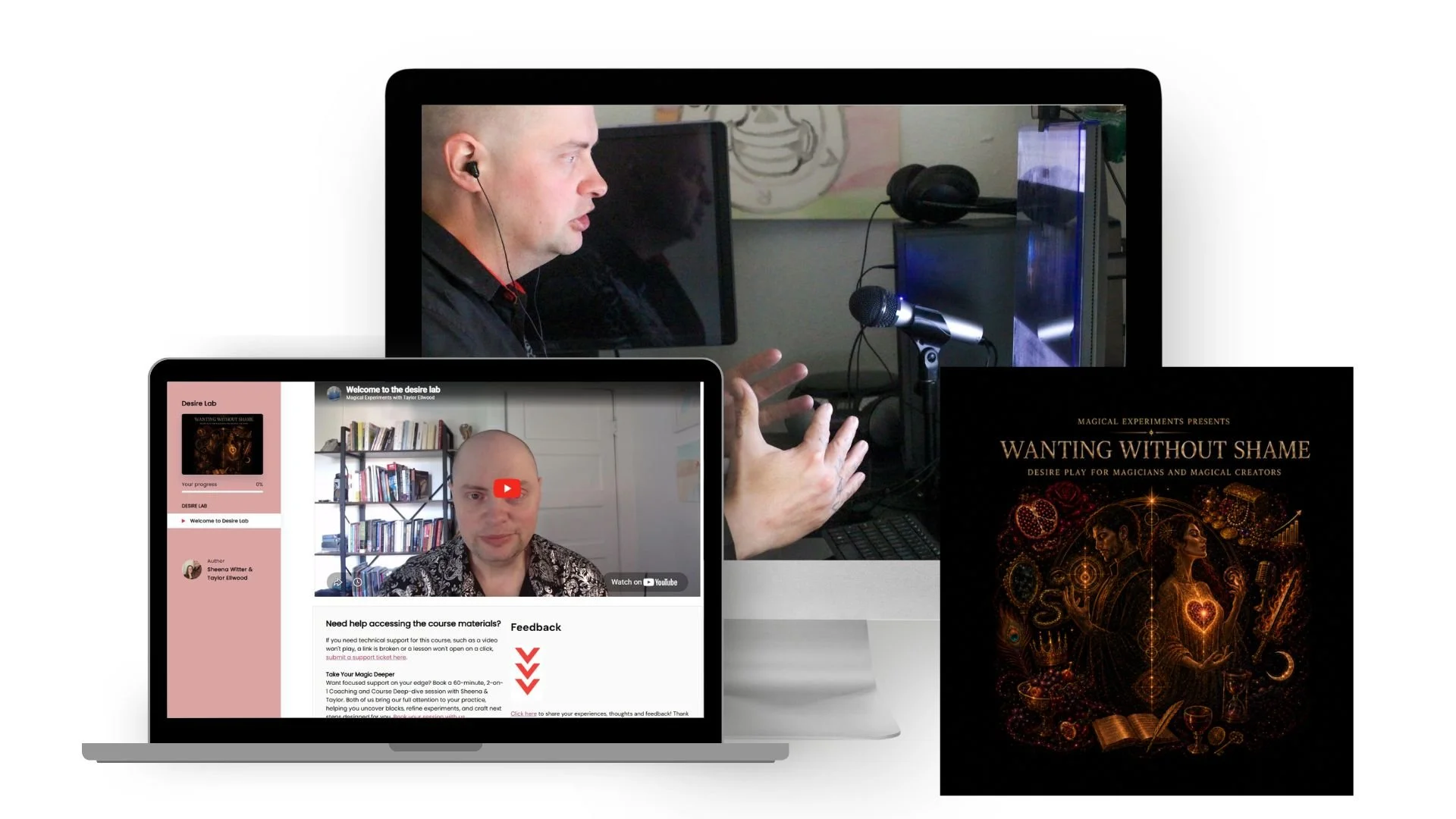
Then you’ll want to join at our next live class, Wanting without Shame, on September 19th at 9:30 am PST.

Desire Play for Magicians and Magical Creators

In the Alchemy Lab (on September 10th), we focus on intention: how to clarify it, how to feel whether it is coherent, and how to notice what blocks it.

In Wanting Without Shame, we go deeper into desire itself.

Because before you can cast clearly, you have to want clearly.

We will explore desire as a:

  • magical current,

  • shadow material,

  • body wisdom,

  • business fuel,

  • and creative force.

We will look at the old selves that distort what we think we want, the desires we have been trained to hide, and the difference between casting from truth and casting from shame, obligation, or spiritual politeness.

For those of you building magical businesses, creating offerings, writing, teaching, reading, healing, making art, or trying to bring your magic into the material world, this is especially potent.

Your business desires matter. Your creative desires matter. Your money desires matter. Your visibility desires matter. Your pleasure, rest, power, devotion, hunger, and ambition all belong in the room.
✨ Ways to Support the Fire ✨

Our hearth grows brighter when you add your spark. Here’s how you can weave your magic with ours:

🔥 Comment & Share — Your questions, stories, and reflections feed the field. Passing our posts along brings new voices and Experimenters into our community.

🔥 Join Our Communal Wealth ExperimentContribute to Abundantia our Magical Experiments Community Wealth Spirit, a current of joyful reciprocity that fuels our work, delightfully returns to you, and ripples blessings back into our wider community.

Intention, Attention, and Magic

Intention is another vital aspect of the magical process. Your intention can be thought of as your attitude and beliefs, but it is also more than that. It is volitional attention. In other words it is focused attention that is dedicated toward a particular task or activity a person is doing. Thus intention is focused attention directed toward accomplishing a specific goal, activity, or task. A magical working can be one such task. Not all forms of attention fit intention. Paying attention to TV or multi-tasking is a very different form of attention as compared to focused attention. When you are watching a TV show, your attention can be focused, but rarely is it focused on achieving an outcome. Instead it is a passive form of attention, with the person being more or less receptive to what s/he is watching. Multi-tasking, on the other hand, is a kind of attention that is focused on doing multiple activities at the same time. However, it is not focused attention, because you are having to split and shift your attention to different tasks and activities. It's also not as productive as people make it out to be. While a person may seem to be doing a lot, s/he doesn't get as much done precisely because s/he is having to shift back and forth between one activity or another.

Intention, as it relates to the magical process, can also be thought of as focusing the will of the magician. In fact, I would argue that setting intention is the first step in the magical process. You've defined your result and now you need to set your intention to actually get that result. If you've answered the questions in the previous chapter, you should have a good idea of any blockages or beliefs that might compromise your ability to set your intention. If you do discover such blockages, it's important to either assess whether you really need the result, or do internal work to undo the blockages. If, however, you find that all of you is completely in agreement with the result you want to manifest, then it's time to set intention.

How to Set Intention

Intention is volitional or directed attention. Setting intention involves picking an action that can be used to embody and express your intention in your magical process. That activity can and usually does involve creating an altered state of consciousness that is representative of your focus. In fact, for magic to be effective, the magician needs to enter a state of mind where all possible distractions are ignored or removed, where what the magician is focused on is the process for manifesting the desired result s/he wants to obtain. In one sense, your intention is an obsession for the duration of the magical working, because it demands that your attention be completely focused on the process, ignoring all else. As such, an altered state of consciousness is ideal because any such state typically creates a hyper awareness of your process, while excluding anything else.

There are two basic types of action a magician can take, both of which can produce an altered state of consciousness. The first type of action is inhibitory. It involves inhibiting sensory awareness in order to enter an altered state of consciousness. The second type of action is excitatory. It involves entering into an excited, hyper state of activity in order to enter into an altered state of mind. Both types of actions are equally effective for setting intention, though some people may find it easier to use one type of action over another.

Some people think that setting intention is as simple as stating in a verbal or written format what your intention is, but that is new age thinking at its worst. An intention isn't set through a statement alone, but through directed and focused attention. If you can enter into an altered state of mind when writing or saying your statement of intent, then you have set your intention, but for the majority of people, it usually requires more effort and activity than just stating your intent. A person who can enter an altered state of mind by just making a statement is someone who has learned to discipline and focus the mind through years of daily practice. For the rest of us, however, it's important to use specific activities as part of the process of harnessing the attention effectively. This is why rituals, which can involve repetitive actions, are so effective. The repetition of the actions creates a rhythm that focuses the attention of the person on the magical process.

Not all magical activity is repetitious. Drawing a sigil isn't repetitious, but it can still be used to set the intention of the magician. What's really crucial about any activity you use for magical work is that it is an activity that focuses you completely and utterly on what you are trying to accomplish. Thus writing can be a magical activity (as Mr. Burroughs displayed time and again), and likewise painting can be a magical activity. The successful setting of intention is the creation of an altered state of mind where all that exists is the activity the magician is doing. Below are some questions to consider as you determine how you'll set intention.

What activities do I already do that create an altered state of mind for me?

What activity will best express my intention, and focus my attention?

What activity is challenging for me to do, but will also focus my attention?