This is how I practice elemental magic without relying on the traditional four or five elements. Instead of deciding that an experience belongs to fire or water, I treat the force I am actually dealing with, movement, stillness, creativity, emptiness, connection, as an element in its own right. I call the practice the Elemental Balancing Ritual and I have worked it for years. If you have found correspondence tables useful but limiting, this is written for you.
When people talk about elemental magic, they usually start with a familiar map. Fire means one set of things. Water means another. Air, Earth, and sometimes Spirit complete the system. The correspondences are useful, and I am not interested in telling anyone that a traditional model is wrong simply because it is traditional. What I discovered is that the model stopped working for me when it became a substitute for encountering what was actually happening.
If I decide in advance that a feeling, a behavior, or a situation belongs to fire, I have already constrained what I can learn from it. I have given it a folder and filed it away. I may have a label for the experience, but I have not necessarily met it. That is the problem I eventually had with correspondence-heavy elemental work. I could make an association, but the association was often doing more work than my actual experience was. [1]
My answer was not to invent a larger and more complicated table of correspondences. It was to treat the thing I was actually working with as an element in its own right. Movement became an element. Stillness became an element. Emptiness, creativity, connection, truth, and love became elements. I approached each one as a force with its own felt presence in my life, instead of forcing it into a category that had been made before I encountered it. [1]
That approach became the basis of what I call the Elemental Balancing Ritual. I have practiced it for years, through changes in my magical work, my creative life, my relationships, my bodywork, and the parts of myself I would rather not have faced. This is not an attempt to turn those years into a tidy success story. It is an account of a practice that repeatedly asked more of me than I expected.
The ritual is not a fixed ceremony with a script that someone else can perform exactly as I do. It is a way of working. I choose a force that is alive in my life, give it sustained attention, and let the work show me what that force actually means in practice. Sometimes that happens in meditation or qi gong. Sometimes it shows up in a difficult conversation, a creative block, a decision I do not want to make, or an old pattern I have been carrying for too long. The point is not to impose an answer. The point is to enter into a relationship with the element and remain present long enough to learn from it.
Why I Stopped Treating the Elements as Categories
Traditional elemental systems can provide an accessible language for experience. They can also become a way to avoid experience. If I say that movement is like fire, I can borrow fire’s associations of activity, will, passion, or transformation. But movement is not only activity. It can be a decision, a transition, a resistance, a regret, a carefully planned action, or the gradual change that occurs because I have finally stopped pretending that something is working.
So I began with a different premise: the force I am working with deserves to be encountered directly. I do not deny its relationship to other forces. I do not treat it as isolated from my body, my history, or the people in my life. I simply refuse to assume that I understand it because I can classify it.
“Instead of associating movement with a classic element, I’ve made it into its own element.” [1]
That distinction matters. Calling movement an elemental force did not give me control over movement. It made me more accountable to it. I had to notice where I was moving too quickly, where I was using activity to avoid a feeling, where I was asking a desire to carry more weight than it could, and where I needed to stop before I made a choice I would later regret.
The same was true of fire. I had to let go of the easy assumption that fire simply meant passion. In my work with fire, I came to see how readily passion can become consumption. A fire consumes its fuel. A fixation can consume a person. If I pursued intensity without asking what I was feeding, I could burn myself and the people around me. [2]
This is why I do not present the Elemental Balancing Ritual as a better correspondence system. It is not. It is a different orientation. It asks, “What is this force doing in my life?” before it asks, “What does this force correspond to?” The answer is often inconvenient. That is part of why the practice has been useful.
How the Practice Actually Works
The practice begins by choosing an element. In my case, that may be a classic element, but it has more often been a force or condition that I need to understand. I do not select a theme because it sounds impressive. I select it because it is already present, because it is creating friction, or because it is asking to be understood in a more complete way.
A working is not a month-long essay assignment. A month is simply a container for attention. I record what happens as I work. That may mean journaling after meditation, noting a pattern in a relationship, writing down an energetic shift during qi gong, or recognizing that the same question is returning through several apparently unrelated situations. The record matters because it keeps me from revising the work into a story that only makes sense in retrospect. It lets me see what I was actually resisting, what I was repeating, and what changed slowly rather than all at once.
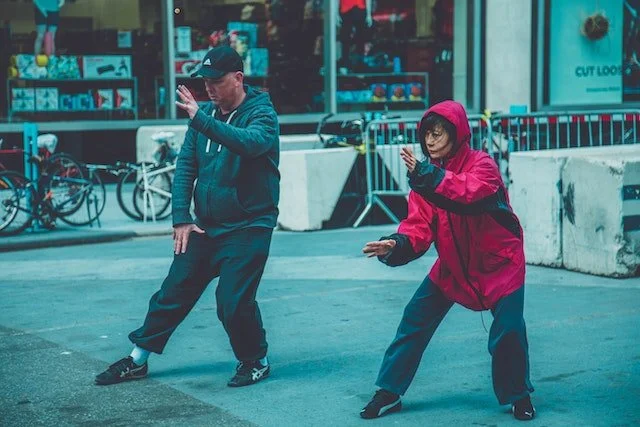
I use whatever practices are appropriate to the work at hand. Taoist dissolving work and qi gong have been important for me, particularly when I am experiencing a blockage, a tension, or an emotion that I am trying to suppress. The practices are not there to make the difficult material disappear. They give me a way to stay with it, notice it, and work with it without immediately acting it out. During one later creativity working, I changed the sequence of my Sphere of Art work, qi gong, meditation, and mediation of the relevant forces in order to see whether the practices could become more synchronous. That is characteristic of this approach. I experiment, pay attention, and revise rather than treating the first arrangement as sacred. [6]
The following table describes the structure I have used. It is not a list of rules, and it is not a promise that every working will develop on schedule. It is the discipline that has allowed the ritual to become more than a series of passing ideas.
Part of the workingWhat I doWhat I am watching for Choose the forceI name a force that is already active in my life, such as movement, stillness, creativity, connection, or emptiness.Whether I am choosing the work because it is real or because I want an escape from what is real. Give it a containerI work with the force over days, weeks, or months, with regular meditation, bodywork, reflection, and notes.Repetition, resistance, unexpected connections, and where the force shows up outside formal practice. Meet the material directlyI use questions, meditation, dissolving work, dream work, conversation, or ordinary observation to stay present with what arises.The distinction between an immediate reaction and the deeper issue beneath it. Adjust the practiceI change a technique, a sequence, or a focus when the work shows that the current approach is no longer adequate.Whether the adjustment is an honest response to the work or another way of avoiding it. Decide whether to continueI review whether the force still has more to teach me, is changing into another force, or has reached a point of integration.Whether I am leaving because the work is complete or because it has become uncomfortable.
The themes do not unfold in a clean line. A month of creativity can expose a problem with connection. A working on stillness can bring up money, responsibility, shame, grief, or a decision about the work I am willing to do. That does not mean the element has failed. It means the element is functioning as a lens. It shows me where the force is already operating, including places I did not expect to find it.
I have learned not to require a particular kind of result. When I began working with connection and truth, I wrote that I did not normally do two elements together, but these did because they went hand in hand. I also wrote that the start was not what I had imagined. That was the point. If I wanted balance, I had to open myself to how balance might show up in ways I did not expect or plan for. [7]
You can learn the full system and how it works in my class The Elemental Balancing Ritual. I walk you through step by step how to connect and work with elements for the purposes of doing deep inner alchemical transformation.
What Fire Taught Me About Desire and Responsibility
My work with fire gave me an early lesson in why direct experience matters. I did not want to reduce fire to enthusiasm or action. In a dialogue with Dragon, fire became a question of passion and consumption. A person can be burned by what they fixate on, desire, or obsess over. The problem is not that desire exists. The problem is what happens when desire takes up all of a person’s energy and becomes the sole way they know how to feel alive. [2]
That shifted the question for me. Instead of asking how I could have more fire, I began asking whether I was consuming something or being consumed by it. There is a difference. Consumption can be a deliberate release. Obsession can be a form of surrender to a force I have refused to understand.
Fire also became a question of responsibility. When I create a spark, I have some responsibility for what I nurture. That might be a creative project, a relationship, a commitment, or any action that invites a consequence into my life. I cannot claim the excitement of beginning something while refusing the responsibility of seeing what I have started through. [2]
This is one reason the ritual is not just inward-looking. Elemental work shows up in consequences. If I am dealing with anger, desire, ambition, or intensity, I have to consider what my actions do to other people. I cannot call an impulse magical simply because it feels strong. A strong feeling is not a justification. It is material for the work.
“Fire just is. The association of doing and activity is meaning attributed to fire.” [2]
In later fire work, I returned to the difference between a warm fire and a vengeful one. I have failed myself and other people. Failure can cause a person to harden, become reactive, or try to burn away the discomfort. It can also force a reassessment of what matters. The choice is not always easy, but I would rather cultivate a fire that warms and sustains than one that keeps recreating the conditions that caused the pain. [2]
Movement Was Not Activity
Movement seemed like an obvious element at first. It was not. I expected movement to be about action, change, and forward momentum. Those were parts of it, but they were not enough.
At one point I began calculating movement. I would look at a possible movement I wanted to make and explore the timeline of that movement, where it could go, what could happen, and what factors would need to change. This gave me a way to assess whether a particular movement was wise, whether I should let it go, and whether the desired result was worth the effort involved. [3]
That was important because I can be impulsive. I have learned that a desire to change something does not automatically make a given action the right movement. Sometimes movement needs design. It needs preparation, timing, and the willingness to see what will be required after the first step is taken. Directed movement is not the same as frantic movement.
Movement also taught me about resistance. It is easy to describe myself as someone who wants change. It is harder to recognize the ways I may be attached to an old role, a familiar failure, or a story about why something cannot change. The force of movement does not only ask, “What are you doing?” It asks, “What are you refusing to move away from?”
The long movement work also showed me that every transition contains its opposite. By the time I was moving out of one long phase, I could feel movement slowing into stillness. This was not a contradiction. It was a reminder that the elements are not clean boxes. A force can change its expression as the work changes. [10]
Stability Was the Capacity to Adapt
The stability working corrected another assumption I had been carrying. I had treated stability as if it meant having the right external conditions: enough money, a predictable schedule, an uninterrupted path, or a situation that would not change. Those are the trappings of stability, but they are not stability itself.
“Real stability comes from within and its not about being in one place or having everything work out just fine.” [12]
I came to see stability as the ability to adjust and adapt to what comes while retaining some sense of purpose and drive. That idea became practical rather than abstract. It meant recognizing where I was seeking external validation, practicing how to read my own emotional reactions, and learning to make choices with their consequences in view. [12]
The working also helped me understand why body practice was part of elemental work for me. In qi gong, intentional movement and breath made me aware of stability as an energetic foundation that allowed movement to occur. Stability was physical, emotional, mental, and energetic at the same time. It involved working elemental energy through the body, developing healthier ways to express emotion, working with thought, and cultivating the energetic body. I did not experience those as separate projects. They became the conditions that allowed other elements to be worked with without being overwhelmed by them. [12]
Stability did not mean avoiding risk. It meant refusing to confuse reactivity with courage. I could still take risks and make decisions, but I had to ask whether the reaction was worth the consequences. That was a useful counterweight to the intensity of fire and the forward pull of movement. [12]
Stillness Was Not Passivity
Stillness was one of the longest workings I did, and it changed my understanding of discipline. At first, stillness sounds like the absence of movement. In practice, it was an active decision not to let every reaction decide the meaning of a situation.
When I was caught in a narrative about another person, I was often not seeing that person. I was seeing the story I had built around them. Stillness gave me a way to notice that. It did not require me to deny an emotion. It required me to acknowledge the emotion without allowing the first heat of it to define the whole context. [9]
That distinction was not theoretical. It mattered in relationships, work, creative disappointments, and the old patterns that came up when I compared myself with other people. In stillness work, I had to sit with disappointment long enough to distinguish between the feeling itself and the narrative I was constructing around it. I could feel something, examine what happened, and make a change without deciding that the feeling was the complete truth. [9]
I stayed with stillness for three years. By Month 35, I was ready to be done. I wrote that I had gotten a great deal from the work, but that it was time to no longer be still. I was ready for something different. At the same time, I knew the work would remain profoundly part of my life. It was embedded deeply in me. [4]
That is what sustained practice can do. It does not necessarily produce a moment in which the element has been mastered and will never return. Instead, it changes the baseline from which I meet the rest of my life.
“Yet the stillness has also taught me to be much more comfortable with me.” [4]
Stillness made me more comfortable with myself. It also made staticness harder to tolerate. Both were true. I had to learn that a practice can be valuable even when its completion means moving on.
Emptiness, Compassion, and the Parts of Myself I Would Rather Avoid
The element of emptiness brought me into a more difficult kind of work. I had spent a great deal of time trying to fill emptiness, escape it, or distract myself from it. That is not unusual. What was difficult was recognizing the patterns I built around avoiding it.
During that working, I began sitting with behaviors I did not like in myself. I noticed passive aggression, pettiness, the ways I could push people away, and the ways I sometimes looked to another person to fill something that was my responsibility to face. I did not find a quick answer. I tried to ask a more useful question: “What will this get you?” [5]
That question slowed me down. Instead of judging myself for the feeling, I could look beneath the action to the wound that was driving it. I could be compassionate without pretending that the behavior was harmless. There is a difference between making excuses and recognizing that a pattern has a history.
Some days of that work were genuinely hard. I wrote about feeling like I was in an ocean, buffeted by waves and trying to hold on to whatever grounding I could find. That is part of the record, and I do not want to erase it. Elemental work can be difficult because it puts me in contact with the material I have kept out of sight. It is not always elegant. [5]
The point was never to make emptiness disappear. I began to understand that I could sit with it, breathe through it, and let it speak instead of treating it as something that had to be immediately filled. That changed how I communicated with people and how I recognized the difference between a superficial want and a deeper need. It also reinforced a lesson I have had to learn more than once: internal work does not come to an end because I have identified one pattern. [5]
Creativity Needed Protection, Not Endless Output
Creativity was another long working, and it forced me to revise what I thought creativity was for. It is easy to romanticize creativity as inspiration, intensity, and productivity. I have felt all of those things. I have also learned that creativity can be damaged by treating it as a resource I can extract from without limit.
By the final month of a two-year creativity working, I understood that I needed to protect my creativity and protect the people, practices, and conditions that helped protect it.
“My creativity is what feeds my soul, but its also my livelihood.” [6]
To let anything consistently get in the way of it is to disrespect a fundamental part of myself. [6]
That realization affected how I worked. Instead of trying to write and publish a book every month, I began to recognize the need to slow down, pace myself, and take care of myself. The result was not withdrawal from the work. It was more focused writing and a better relationship with the work itself. [6]
Creativity also showed me that a theme can become most visible when I feel least creative. Personal conflict, grief, anxiety, and emotional compartmentalization all affected how I was able to work. I had to see that my creative life was not separate from those things. When I worked with the emotions I had been bottling up, the creativity working did not become less relevant. It became more honest.
At the end of that phase, I wrote that the Elemental Balancing Ritual had never been easy because it requires me to face the areas of my life that require change. I also wrote that without it, my life would have been much more chaotic. That is not a claim that the ritual prevents chaos. It is an acknowledgment that the practice gives me a path forward when I am willing to follow it. [6]
Connection and Truth Cannot Be Separated
Connection and truth became a paired working because I found that they were not separable. I could say I wanted connection while still hiding from my own feelings, avoiding accountability, or trying to manage how I was seen. I could insist on truth while using it as a weapon instead of a way of becoming more present.
The work quickly turned toward self-worth, expectations, old relational patterns, and the question of whether I valued myself for who I was or only for what I could do for others. I had to examine the gap between what I thought and felt internally and the actions I was taking. If those things were not consistent, I needed to ask why. [7]
This was not simply a private matter. Connection is relational. It required more honest communication, a willingness to recognize the impact of my choices, and a willingness to sit with pain I had caused without immediately trying to escape from it. I found that acceptance was not passive surrender. It was acknowledging what was present so that I could stop spending all of my energy fighting the fact that it was present. [7]
This phase also illustrates why the ritual should not be mistaken for a purely psychological self-help system. I worked with spirits, including Suvuviel and She Who Watches, as part of the connection and truth work. I experienced them as presences and guides. But the work did not become a guide to spirit contact. The spirits did not exempt me from responsibility. If anything, their presence made it harder to avoid the work I needed to do. [7]
Is This the Same as Working With Elemental Spirits?
I have worked with spirits, archangels, goddesses, places, and other presences over the years. Those relationships appear throughout my work. Dragon was part of my fire work. Suvuviel and She Who Watches were important to my connection and truth work. In other workings, I have experienced particular currents, contacts, and spiritual relationships that shaped how I understood the force I was engaging.
That does not make the Elemental Balancing Ritual a guide to elemental spirits or elemental beings. Those are related but different subjects. My working with classic elemental spirits such as sylphs and gnomes, for example, has included a separate walking practice in which I open myself to their energy and experiences through a specific state of being. That is a valid subject in its own right, but it is not the central method of this ritual. [11]
The core of the ritual is working with a force as an element, whether or not a spirit is involved. The main question is not, “Which entity will tell me what this element means?” The main question is, “How is this force already operating in my life, and what happens when I stop trying to reduce it to a correspondence?”
The techniques are similarly secondary to the relationship. I have used meditation, qi gong, Taoist dissolving work, dream work, and the Sphere of Art. I have changed the order of those practices when the work showed me that a different arrangement might be needed. During an earlier switchover from emptiness to time, I also shifted to an elemental fusion system because my existing daily meditations no longer matched the energetic changes I was experiencing. [8]
None of these techniques are universal requirements. They are tools that have been useful in my own practice. The practice remains experimental because I am willing to observe, assess, and adjust rather than declaring that one method must fit every element and every stage of life.
What Long-Cycle Practice Changed
The most important thing the Elemental Balancing Ritual taught me is that a force does not reveal itself all at once. The first month can be useful. It can also be misleading. It is easy to mistake an early insight for the whole working, particularly when the insight is emotionally satisfying or seems to solve something I have been struggling with.
A longer cycle makes that harder. It exposes repetition. It exposes the difference between recognizing a pattern and changing my relationship to it. It shows me that a force can move through different parts of my life over time. In creativity, I began with ideas about output and purpose, but eventually I had to confront pace, protection, accountability, and emotional presence. In stillness, I began with the need to pause but stayed long enough to learn the difference between presence and stagnation. [4] [6]
Long-cycle work also creates transitions. When one element is ending, the next may already be appearing. At the end of creativity, connection and truth were beginning to show up. I could see them as preparatory work before I formally started that next phase. The elements do not wait neatly in a queue. They overlap because life overlaps. [6]
This is why I do not think a reader needs to copy my timelines. I worked with some forces for months and some for years because the work called for it, not because I had a universal calendar. A shorter period may show that the force needs more attention. A longer period may show that the working has become an identity, a refuge, or a form of avoidance. The decision to continue should come from the work itself, not from a rule about how long a ritual ought to last.
How Do You Start Working This Way?
Choose one force that is present in your life now. It might be a familiar classical element, but it does not have to be. It could be a force like responsibility, grief, trust, hunger, attention, courage, or rest. The important thing is that it is real enough to resist easy explanation.
Give yourself a defined period of attention. A month is useful because it is long enough to move beyond a first impression, but it is not a promise that the work will be finished at the end of the month. Keep notes. Notice where the force appears in formal practice, but also notice where it shows up in your choices, your work, your body, and your relationships.
Ask direct questions. What is this force doing in my life? Where am I trying to control it? Where am I letting it control me? What am I calling an elemental truth that may actually be an old story, a fear, or a convenient excuse? The questions should not be used to interrogate yourself into submission. They should help you become more honest about what is present.
Use practices you can genuinely sustain. Meditation, walking, journaling, conversation, bodywork, art, or another discipline may provide a container. What matters is regular contact and a willingness to record what happens without turning every experience into proof of a theory. If something becomes too intense, too confusing, or too destabilizing, slow down. There is no prize for forcing an element to reveal itself on command.
At the end of the period, do not only ask whether you got a result. Ask whether your relationship to the force has changed. Are you more capable of recognizing it? Have you identified a pattern that needs more work? Has the element become more complex than it was when you started? Those questions will tell you more than a neat conclusion will.
If you want a full walkthrough of this process sign up for the elemental balancing ritual class, where I walk you through step by step how to apply this process to your life and magical work.
Why I Still Call It Balancing
Balance does not mean a life without difficulty. It does not mean that every force reaches a permanent equilibrium. I have not found that kind of balance to be real or useful.
For me, balance means being willing to respond when something in my life has become distorted, neglected, overfed, or disconnected from the rest of me. It means letting a force be more than a label. It means recognizing that the pursuit of balance may show up in ways I do not expect and would not have chosen. [7]
The Elemental Balancing Ritual has changed because I have changed. That is not a failure of the practice. It is the reason I continue to value it. I do not need a system that tells me everything before I begin. I need a practice that asks me to pay attention, tells the truth about what I find, and gives me a way to keep working when the answer is not convenient.
References