I’ve lately been pondering the question of why spirits work with us, prompted in part by reading a book where the author claims that angels have no choice but to do what we ask them to do. I don’t agree with that perspective and my experiences with Angels, and for that matter other spirits, doesn’t fall in line this approach. It also seems pretty thankless for any spirit to work us because they have to. But I recognize as well that I’m making a human assumption about the motivation of beings that is likely not accurate.
How to draw on multiple sources of energy for your magical workings
One of the questions that recently came up in the magical experiments Facebook Group was if its possible to draw on multiple sources of energy, instead of using your own for magical workings. The short, flippant answer is yes, but I want to share in detail what this really looks like, because this is an approach to magic that I specialize in.
In my approach to magical workings, one of the questions I ask myself is how best to fuel my magical workings. I’ve rarely taken the approach of using my own energy, because a person’s energy is limited ultimately, and I’d rather focus that energy on my health and well-being. So when I consider the fuel for the magical working, what I look is how the magical working can be tied into existing efforts and actions already being taken. The reason is because those actions and efforts involve some energy, so why not harness what you’re doing and turn it into metaphysical fuel as well.
For example, if you’re looking for a job, take the effort you put into filling out applications, sending in resumes, and interviewing and make it into fuel for whatever workings you’re doing. What this lets you do is take what you’re already doing and turn it into a potent source of fuel for your working that also helps you accomplish your result.
Emotions are another source of energy that are often underutilized. You are already feeling the emotion, so why not take feeling and use it to charge your working? I’ve applied emotions to my own magical workings, in situations where the emotions would otherwise get in the way. By providing my emotions an outlet through the magical working, I’m not letting them become an obsession that blocks me from achieving a result. Instead I’m turning them into a source of energy that benefits the working and keeps me from fixating on the situation I’m applying the magic to.
Of course, in both examples above, you might note that I’m still, to some degree drawing on my own energy. But what you should also be noted is that what I’m actually drawing on is the expression of that energy. In other words, the energy is being directed somewhere. I’m just choosing to optimize it so that it really does two things instead of one.
That said, there are still other sources of energy that we can draw on. A person’s attention is one such source. even the act of casually paying attention is an expenditure of effort on the part of the person paying attention and this can be taken and applied to magical workings. I call this attention stacking, because you take the attention someone provides you and redirect it toward a magical working, to fuel that working.
Then there’s the case of harnessing other sources of energy for your magical purposes, such as elemental and planetary energies. In such cases you can draw on these energies or work with a spirit that can mediate those energies for you. I have set up specific magical tools that I use for the purposes of channeling such energies, and I apply those tools as needed. Such tools can be talismans that a person has created, or an active tool that you might use like a wand or an athame.
My magical workings are set up so that they draw on multiple sources of energy. I may setup the initial working and charge it with expressed energy, such as emotions, then draw on relevant external sources of energy that can also help empower the working. By using multiple sources to empower the magic working, I effectively keep it charged until its realization…and even after because I set my workings up to be retroactively charged even after the fact. That’s my approach to using multiple sources of energy for my magical workings. What’s yours?
Explore related entries in the Library
How I evaluate my magical workings
Lately I’ve been thinking a lot about results and magic and how a person goes about evaluating magical work. The obvious answer is that you look at whether or not you’ve gotten the result, and certainly that is helpful, but what I’ve been realizing about results is that too often we stop short at the result itself and fail to examine the ramifications and consequences of achieving or not achieving the result. The focus is just on the result itself, but not what comes after.
I’ve observed before that one of the tendencies I see in magical workings is a tendency to treat the desired result as the end itself. What’s problematic about that approach is that the result rarely is the itself. Instead the result is typically something just another means to the actual end, but we’ve ignored the actual end to focus on the result, because on the surface the achievement of the result seems to resolve the problem. I got the result and the problem is solved…but is it?
How to create magical space in your workplace
The Place of Ecstasy in Magic
I was recently reading Stealing Fire, which is a book that explores states of ecstasy and how people are harnessing those states deliberately. If I have one complaint about the book its that they never really touch on ecstasy shows up in magical practices, but it got me to thinking about the place of ecstasy in magic and why ecstatic states of being are so important to magical work.
I’d argue that any altered state of consciousness can be lumped under ecstasy of some sort because what seems to be a defining characteristic of ecstasy is an the experience of altered consciousness. And ecstasy of some type seems to be essential to magical practices, because what ecstasy necessarily provides us is the suspension of the everyday conscious mind with its attendant disbelief. I think of an ecstatic state as a state where your perception of possibilities and reality is intertwined, where your awareness of past, present and future combines to create a singular moment where you are, and you can connect a desired possibility and provide it a path toward manifestation. An ecstatic state of consciousness is a state of flow.
How to pick your pop culture for pop culture magic
I’ve recently started playing a game called in Inquisitor-Martyr, set in the Warhammer 40k universe, which a is a dystopic universe where humanity has access to advanced technology, but also a medieval mindset about technology. At the same time, humanity is beset by various alien menaces and the forces of chaos. I enjoy the game, but I would never create a pop culture magic working or system based off the Warhammer universe.
In this article, I want to share some thoughts on how to pick your pop culture for pop culture magic and also demonstrate why a viable option for pop culture magic may not be ideal, for other reasons. At the same time I’m going to compare and contrast the 40k universe with that of Kingdom Hearts (for purposes of pop culture magic), which is on the opposite end of the spectrum when it comes to pop culture based off fantasy.
How Embodiment connects you to your environment
The majority of my current magical experimentation is on experiential embodiment, which is focused on entering into a conscious relationship with the body, as opposed to merely inhabiting it and treating it as an object. Yet what I’m finding with this work is that it’s not merely helping me continue to collaborate with my body as a living universe in its own right, but also connecting me more intimately with the environment and world I live in, as well as with the fellow living beings I share this space with.
I’m reading the Spell of the Sensuous and Processmind and both books explore how connecting with your body also opens you up to connect with your environment. What both authors recognize is that the choice to be sensually and experientially present with your body necessarily also opens you up to becoming present with the space you are interacting with in your everyday life. Embodiment teaches us not to take for granted the world we live in or the bodies we are fortunate enough to have access to.
Art as active magic
Art is one of the techniques I use for working with magic. A painting or sculpture can be used to help embody and express a magical concept or provide a “home” of sorts for an entity or spirit. But art can also be used to set up your environment for magical work, or it can become a shrine and altar to the spirits you’re working with. It’s these latter two aspects I want to explore, as well as share a few examples of my own art employed for this purpose.
At the same time I also want to explore something else that I feel underpins the two points above: Art is an active collaborator in your magical work. I mention this because I think that other than the act of creating art, art is typically considered to be passive. And what I mean by that is that you see art on a wall and appreciate it, but its just there, in the background, or is it?
A Magical Stillness is now available
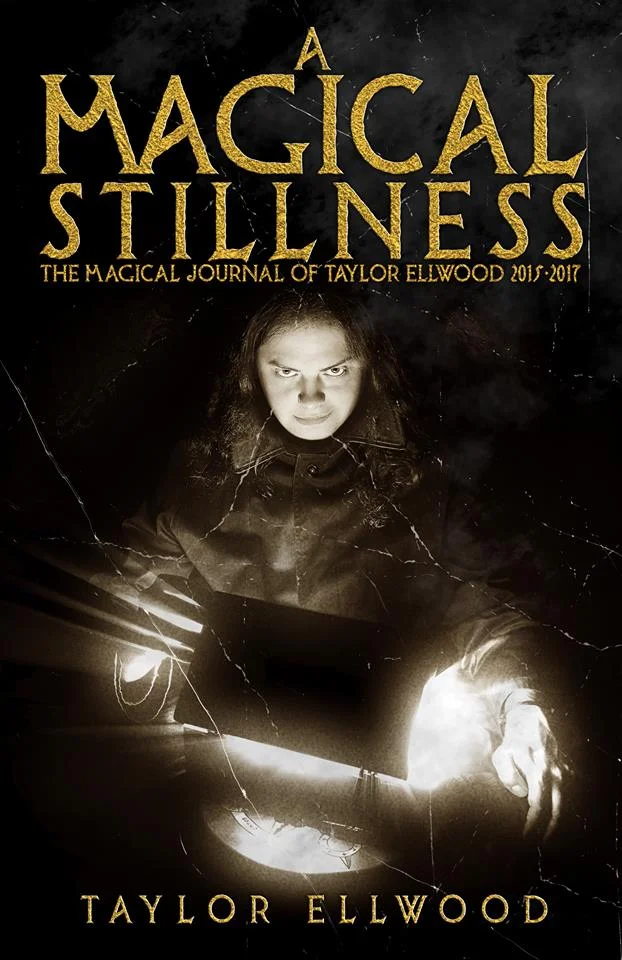
My latest book, A Magical Stillness is now available. This is the 4th volume in the magical journal series and contains all my blog articles from 2015-2017. Click the button below to pick up your copy.
Liminal Space and experiential magic

Photo by oldskool photography on Unsplash
I’ve started re-reading the Spell of the Sensuous, which is one of those books I’d make mandatory for any magician. In the book the author notes that the magician’s place is on the edge of society, mediating both the human community and the community of nature and spirits that the magician connects with. This role is essential and the magician maintains it in order to connect with the wild, with the spirits and as a result bring about equilibrium in the human community.
The author shares this contextual definition based on his experiences in SE Asia, and so I found myself asking if what he defined as the magician’s place is applicable to Western society. And I think it is. Not the least perhaps because I’ve always seen myself on the edge and that I prefer to live in hard to find places that have a connection to nature, but just as importantly because I think that regardless of where you live, its necessary to find a way to connect with the larger world around you, and with what awaits in that world, both in terms of life and spirit.
The magician’s space is liminal space, that place between worlds where everything is possible, and yet until something is done, everything is also unmanifest. In such a space the magician has access to all the experiences and possibilities that she needs access to and most importantly to the allies she needs access to, but such relationships must be cultivated purposefully. If you want to connect with a spirit in the liminal space, you must necessarily seek that spirit out, but here’s where experience comes into play because how you connect with that spirit is through the awareness of experience. You aren’t just saying the name of the spirit or using a sigil to invoke or evoke the spirit. You’re feeling the vibrations of the name, as you say it, directing the name inward and outward. You’re paying attention to any sensations that feel unusual, any sensation which speaks to the presence of the spirit coming through. You are making space for something to happen and going outside of normative consciousness to connect with the experience you are having.
The focus on experience is the cultivation of the liminal, the awareness of subtle nuances and sensations that signal here is magic, here is possibility becoming into reality. It’s tapping into the numinous and letting that come through you and using your sensorial awareness to fully embrace the experience and allow it to take you out your everyday consciousness. And this is something that can happen any moment, at any given time. For instance, I can take a walk and during that walk if I choose I can connect to the spirit world by simply opening my perceptions up and choosing to let in every experience that is available. Underneath the ordinary there is often more going on that we don’t recognize or see., because we’ve blocked it out. Now we can use ritual, use various magical methods to get us there, but i’d argue we can also simply learn to open ourselves to what is around us, and challenge our awareness by letting in what we normally block out.
When I first started practicing magic, I spent a good half a year just learning different techniques of opening the perceptions and connecting with the elemental, underworld, cosmic, and other altered states of reality. Why did I spend so much time just focusing on opening up my perceptions? I realized that if I wanted to do magic I first needed to teach myself how to be aware of magic in all of its forms. Even now, so many years later, I still continue to work on honing my awareness and perception because I find that it keeps me open to all the ways magic can show up.
In the book I mentioned above, the author watches as some people in SE Asia leave an offering to the spirits and then discovers that the spirits are ants. Many people would look at that and say there’s nothing magical there, but what the author was able to see was the spiritual significance of the moment and recognize that what the people making the offering were doing was establishing and maintaining a relationship with the life around them, and as a result were connecting with the spiritual world in ways that were subtle yet significant. We might ask ourselves if we can’t do the same by simply discovering that any given moment and how we approach that moment can provide us an opportunity to discover and work magic. How then might that change our relationships everyday in the world we live and in the routines of the day we choose to engage in? How might our magical practice evolve if we allow ourselves to fully subsume ourselves in the experience and let it speak through us?
Explore related entries in the Library
3 Lessons you can learn from the Chilling Adventures of Sabrina
Experience and the art of magic
If process is the methodology of magic, experience is the art of magic.
When I talk about experience, I’m talking about engaging your magical work on a sensorial level, opening yourself to the subtle nuances of magic as it expresses itself in your life.
Experiential aspects of magic can happen during ritual workings. In fact a lot of magical workings are purposely designed to engage the magician sensually in order to alter the consciousness and prepare the magician for the spiritual workings, but ritual is just one example of experiential work in magic.
Assumptions, Desire and Doubt in in Magical Practice
Lately I’ve had a few other magicians express doubts about their magical work and when they tell me they feel doubt they feel as if expressing that doubt is somehow bad and makes them less of a magician. I actually find it to be refreshing and see it as a good thing to express and feel. Having some doubt is healthy and is what keeps us grounded when it comes to magic and life. The danger of not entertaining some doubts is that you can make assumptions about your magical work that you aren’t verifying. Doubt is what helps us do our due diligence and check against what we’re doing and how its aligning with the experiences we’re having.
I find that where a magician can start making assumptions is when they don’t entertain any doubt. Certainly I have sometimes made assumptions instead of critically questioning what I was experiencing. A good example of this would be when a situation seems to resolve in your favor, with everything lining up the way you would expect it to when you’ve done a magical working…but you haven’t done a magical working.
Magic for Experience vs Magic for Results
I’ve been thinking a lot lately about the difference between magic done for the sake of experience and magic done for the sake of results. I don’t think either type of magic necessarily better than the other, but I think the underlying purpose for doing the magical work is significantly different and worth recognizing because it also informs your own motivations for why you’re doing magic.
I’ll admit that a lot of my thought around this topic is driven by my own magical experiences and experiments of late, which have driven more by a desire for the experience than for a specific outcome. Practicing magic for the sake of experience I find is changing my perspective on magic. Before I get into that further though let’s briefly define and clarify what magic for results and magic for experience looks like.
How I use dreams for my creative work
One of the ways I’ve been cultivating my creativity has involved using lucid dreams to discover what I should write about, both for fiction and nonfiction. In order to have lucid dreams I’ve found it helpful to change some of my sleep patterns, just enough so I can remember my dreams and still get enough sleep for my health.
If I get a full night of sleep I usually need 7 hours. When I’m doing dream work, I aim for getting around 6 hours of sleep. I find that if I only sleep 6 hours, I wake up around the time that I’m having vivid dreams and can remember those dreams. If I have a journal on hand, then I can write the dream down.
How to maintain a consistent magical practice
One of the topics that comes up frequently when I talk with other magicians is the challenges they have around doing a consistent practice of magic. They want a consistent practice of magic, they start to do it, but then the consistent practice falls away. They may have done the practice for multiple weeks in a row, but suddenly they stop.
It’s a frustrating experience when you are trying to develop a consistent practice and you’re doing well with it and then suddenly you aren’t. You can feel like a failure, like you aren’t really a magician, because you can’t seem to stick with a practice. And when you feel that way it can discourage you from even trying to practice magic.
How to Ground yourself after doing deep work
Whenever I’ve come home from a festival or a weekend intensive or wrapped up an intense working, I find that one of the challenges I’ve face is how do I come back from that intense experience. After all I’ve stepped away from my mundane life for a period of time and experienced something outside the norm…and now I have to go back.
Chances are that if you’ve practiced magic for any length of time you’ve had this experience too. And the question is how do you come back from that and go back to your normal life? It sometimes feels like culture shock when you try to go back to the regular routines of life because where you were spiritually, mentally, and physically was so different and going back to your regular life is a shock.
How to define and enhance the power source of magical workings
The other day I had someone ask me how you could go about giving more power to a spell or ritual. It's not an unusual question, because of one key word: Power. How do we put more oomph, more power into our magical workings? I think a better question to ask though is do we even need more power in order to get a desired result? Along with that, let's also ask what the best source of power ought to be for what we're doing with our magical workings.
On the surface more power seems like the ideal response. Not getting what you want? Throw more power into it. That'll tip the momentum in your favor. But in my experience brute power rarely does the trick and the reason is because power, in and of itself, isn't enough to get what you want, if you understand what all that power is going to.
Are the 4 quarter Archangels the same as the Guardians of the Watchtowers?

Photo by Luke Stackpoole on Unsplash
I was recently asked if the Guardians of the watchtowers are the same as Archangels. The reason I was asked is because a lot of Magicians call angels to their circle or the Guardians of the watchtowers. It's a good question to ask, and since I've been doing my own work around the archangels of the quarters, I thought I would answer it.
The short answer is that the Archangels aren't the same as the Guardians of the watchtowers. They are each their own distinctive set of beings. Frater Barrabbas has an excellent book out about this very topic called Spirit Conjuring for Witches: Magical Evocation Simplified (Affiliate link), where he explores this topic in depth.
My own experience with the Archangels also doesn't suggest that they're the guardians of the watchtowers, but rather that they have their own distinct roles which should be explored in depth. In fact, this is why I always recommend doing thorough research on what spirits you'll work with so that you don't create this blending of function, which isn't accurate.
For example, one of the reasons you develop a correspondence table with a spirit you work with is because the correspondence table speaks to the relationships and associations that are relevant to the spirit. For example if we work with the archangel Raphael, what we're initially doing is learning about who that spirit is and what functions/associations/attributes etc are aligned with Raphael.

What happens as a result is that we build a profile that we use every time we work with Raphael. That profile allows us to not only evoke or invoke Raphael, but also connect with the powers that are associated with Raphael. We learn what those powers are by taking the time to build a relationship, but the benefit we get is that when we call Raphael up, we're also connecting with those powers. What Raphael does for us is mediate those powers so that we have access to exactly what we can handle and no more than that.
Circling back around to the initial question posed above, the reason its important to have a distinct understanding of the spirits in their own rights, as opposed to blending them together is because of what they represent and mediate. By understanding the function/role of Raphael in a separate context from that of a guardian of the watchtower, we can readily appreciate the role/function of each and employ each appropriately in our magical workings.
Now it could be argued that if a guardian of the watch tower and Raphael occupy the same quarter, won't they have the same associations? We shouldn't assume they will, because although they may share a quarter and some associations in common, there may also be specific differences. There's also the simple fact that if I work with Raphael that's who I'm working with. Blending the identities of spirits for your own purpose disrespects the spirits you're working with and also takes away from the potency of the connection.
I recommend that whatever system of magic you work with or create that you remember that the relationship you form with a given spirit is really a discovery of that spirit and what it represents, as well as how that relationship can be applied to the other spiritual work you're doing. Don't try to force connections...simply discover and be open to learning. The rest will reveal itself as needed.
Explore related entries in the Library
Why magic for your self isn't always effective
I was asked by someone why magic he was doing for himself was less effective. He told me that that until recently the magic done for himself had worked fine, but that then suddenly became less effective. He wondered if it was because he had put a shield up or if the magic was less effective because it as an attempt to avoid self sabotage. Finally he asked what could be done when your magic seemed less effective.
I don't know the specifics of what he was trying to do with his magical work, but some thoughts did come to mind, based on my own experiences and helping other people diagnose issues they are having with their magical practice. I find that when a person isn't getting a result or their magic is less effective, its usually because they are self-sabotaging in some way. They may not really want what they think they want. Or they may not feel they are worthy of what they want. Additionally there may be some internal resistance because what they want goes against some moral or ethical code.